

CBT for Perfectionism
Online CBT for adults whose high standards, fear of failure or self-criticism are starting to take over.
Perfectionism can look productive from the outside.
You may work hard, achieve a lot and hold yourself to high standards. But underneath that can sit a constant sense that you should be doing more, doing better or avoiding mistakes altogether.
You might spend too long checking your work, put things off because you’re worried they won’t be good enough, compare yourself with other people, or struggle to switch off once something is finished.
Even when things go well, the relief often doesn’t last.
CBT for perfectionism focuses on understanding the rules and behaviours that keep this cycle going, then testing out more flexible ways of working, performing and evaluating yourself.
When high standards become a problem
Having high standards isn’t necessarily a problem.
Perfectionism becomes more difficult when your self-worth depends heavily on meeting those standards, and when falling short feels like failure rather than something ordinary and manageable.
You may notice things like:
spending far longer on tasks than other people
repeatedly checking or correcting your work
procrastinating because starting feels risky
avoiding tasks where you might not perform well
feeling anxious about mistakes or criticism
comparing yourself constantly with other people
struggling to recognise success
moving the goalposts after you achieve something
feeling guilty when you rest
being much harsher with yourself than you would be with someone else
believing that anything less than your best is unacceptable
The problem isn’t simply that you “care too much”.
It’s usually the system underneath it.
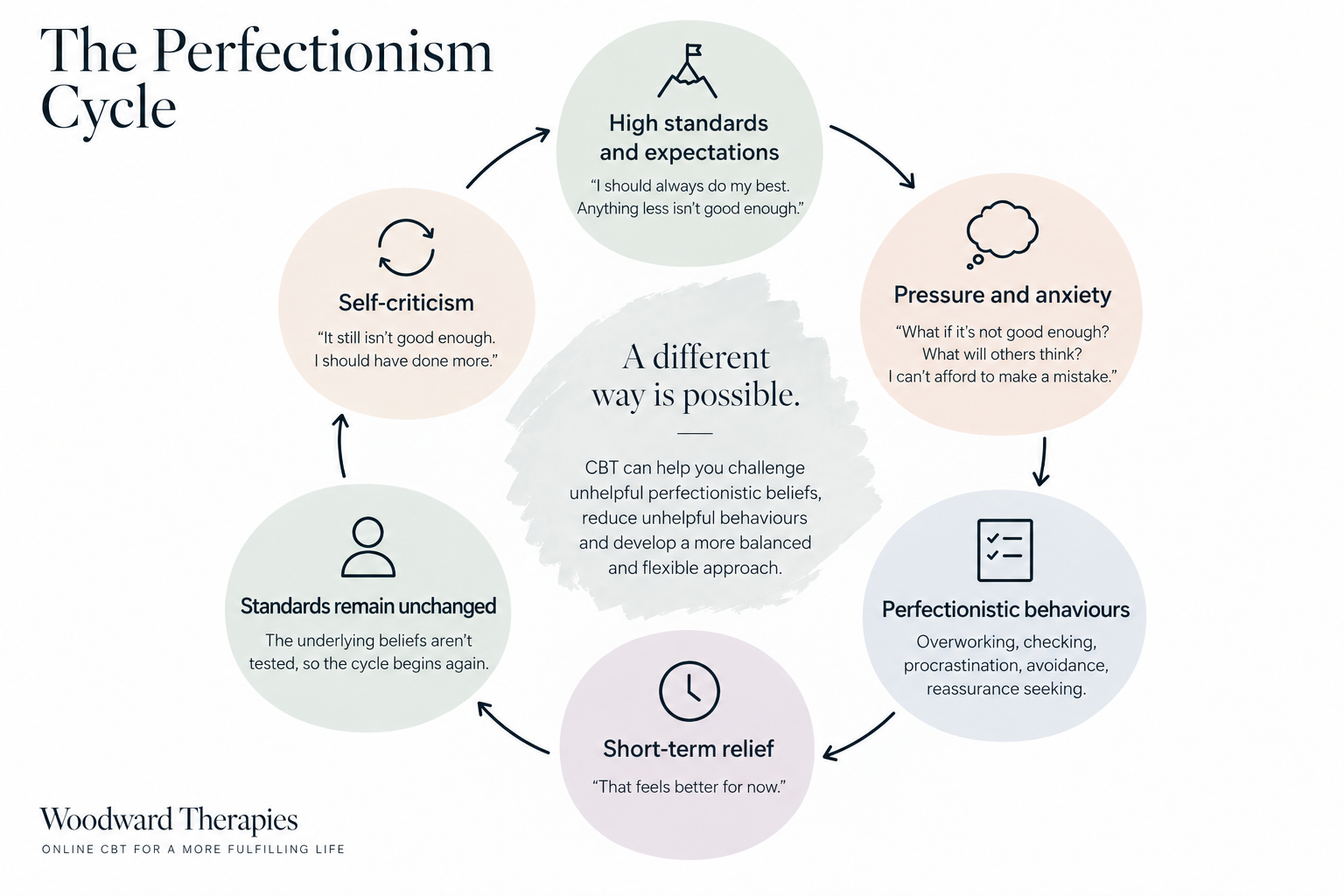
The perfectionism cycle
Perfectionism often runs on a set of rigid assumptions:
“If I don’t do this properly, I’ve failed.”
“I should always be productive.”
“If someone sees a mistake, they’ll think less of me.”
“Good enough isn’t good enough.”
These beliefs can lead to behaviours such as over-preparing, excessive checking, reassurance seeking, procrastination and avoidance.
Those behaviours can reduce anxiety in the short term.
But they also prevent you from finding out whether the standards were actually necessary in the first place.
The result is often a cycle:
High standards → pressure and anxiety → checking, overworking or avoidance → short-term relief → standards remain unchanged
CBT aims to interrupt that cycle.
How CBT for perfectionism works
Treatment isn’t about making you careless or lowering every standard you have.
The aim is to help you distinguish between helpful striving and rules that are so rigid they make your life smaller.
We may work on:
identifying the standards and rules you apply to yourself
understanding how perfectionism developed and what keeps it going
reducing excessive checking and over-preparation
tackling procrastination and avoidance
testing beliefs about mistakes and failure
learning to complete tasks to a realistic standard
reducing comparison and reassurance seeking
broadening the areas of life that contribute to your self-worth
developing a more balanced response to setbacks
reducing self-criticism
A lot of the work happens between sessions.
That might involve deliberately submitting something without checking it again, stopping work at a set time, allowing a small mistake to remain, or testing what actually happens when you aim for good enough rather than perfect.
The point isn’t to convince yourself that mistakes don’t matter.
It’s to find out whether the consequences you fear are actually as severe as perfectionism predicts.
Perfectionism and self-esteem
Perfectionism often overlaps with low self-esteem.
You may have learned, explicitly or implicitly, that being successful, useful, productive or impressive is what makes you worthwhile.
That can create a fairly brutal arrangement:
When you succeed, you briefly feel acceptable.
When you struggle, your whole view of yourself takes a hit.
Therapy can therefore involve looking beyond performance itself and examining the rules you use to judge your value as a person.
This is particularly relevant if you recognise a strong inner critic, difficulty accepting praise, or a tendency to dismiss your achievements.
Who I work with
I work with adults experiencing perfectionism alongside difficulties such as:
anxiety
low self-esteem
self-criticism
procrastination
work-related stress
fear of failure
obsessive checking
social anxiety
depression
You don’t need to know whether “perfectionism” is the right label before getting in touch.
We can use an initial consultation to understand what’s happening and whether CBT looks like a sensible fit.
What to expect
Sessions are online and usually last 50 minutes.
We’ll start by building a shared understanding of the patterns causing difficulty and what appears to be maintaining them.
From there, treatment is structured around your goals.
That means sessions won’t just involve talking about the week. We’ll use what happens in your everyday life to test the beliefs and behaviours keeping the problem going.
Frequently asked questions
-
No. Perfectionism isn’t a standalone mental-health diagnosis, but it can contribute to difficulties including anxiety, depression, OCD, eating disorders and low self-esteem.
-
That isn’t the aim.
Treatment focuses on reducing the parts of perfectionism that create unnecessary distress or interfere with your life while retaining standards that are genuinely useful to you.
-
That’s common.
The question isn’t whether high standards have ever helped you. It’s whether the way you pursue them now is costing more than it gives back.
-
It varies depending on the difficulty and what else is going on. We would agree goals and review progress rather than committing you to an arbitrary number of sessions.
Ready to talk?
If perfectionism, self-criticism or fear of failure is taking up too much space, you can book a free 15-minute consultation to discuss whether CBT might help.