

CBT for Health Anxiety
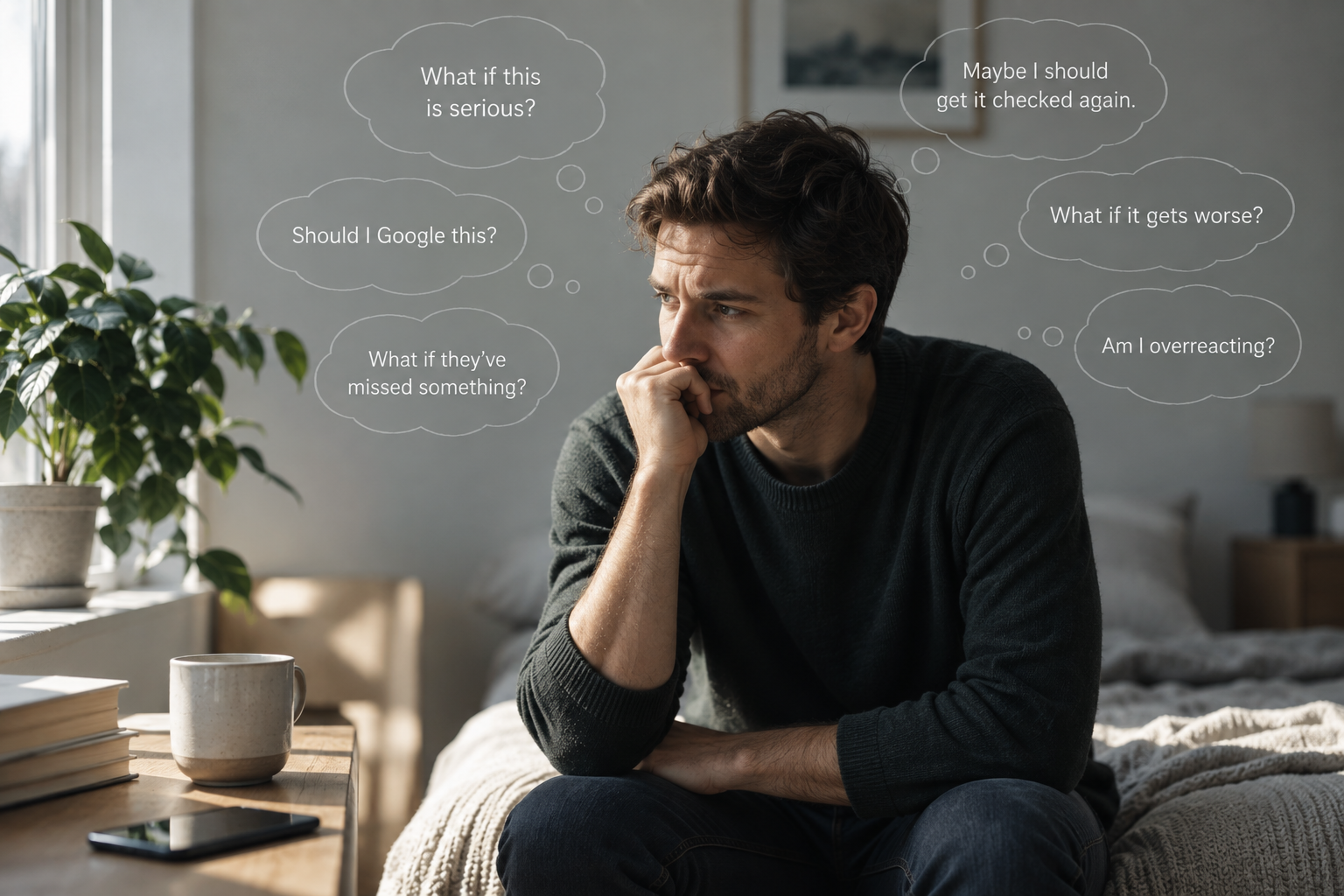
Online CBT for adults who find themselves repeatedly checking symptoms, seeking reassurance, Googling health concerns or struggling to trust that they’re okay.
Health anxiety can make ordinary bodily sensations feel difficult to ignore.
A headache, change in heart rate, pain, lump, mark or unusual sensation can quickly become something that needs to be understood, checked or ruled out.
You may seek reassurance from other people, search symptoms online, monitor your body closely or arrange repeated checks. These things can bring relief.
But often, the relief doesn’t last.
Another sensation appears. Another doubt creeps in. And the cycle starts again.
CBT for health anxiety focuses on understanding what keeps this cycle going and helping you develop a different relationship with uncertainty, bodily sensations and health-related thoughts.
When concern about your health becomes hard to switch off
Most people notice symptoms or worry about their health from time to time.
Health anxiety becomes more difficult when worry starts taking up significant time, affecting your decisions or repeatedly pulling you into checking and reassurance.
You might notice yourself:
checking your body for lumps, changes or unusual sensations
repeatedly Googling symptoms
asking partners, friends or family whether something looks normal
seeking repeated reassurance from healthcare professionals
monitoring your heart rate, breathing, skin or other bodily sensations
avoiding exercise or activities because you’re worried about what symptoms might mean
avoiding medical information because it feels too triggering
repeatedly examining photographs, test results or previous medical information
comparing your symptoms with other people’s experiences
struggling to trust reassurance once you’ve received it
thinking, “But what if they’ve missed something?”
The problem is rarely a lack of reassurance.
Often, it’s what happens after reassurance wears off.
The health anxiety cycle
Health anxiety can become self-reinforcing.
You notice something:
A sensation, symptom, story about illness or change in your body.
Your mind interprets it as potentially dangerous:
“What if this is serious?”
“What if I’ve missed something?”
“What if the doctor got it wrong?”
Anxiety rises.
That can lead to:
body checking
Googling
reassurance seeking
symptom monitoring
avoiding activity
repeated medical checking
mentally reviewing the evidence
comparing yourself with other people
These behaviours usually make sense in the moment.
They’re attempts to become certain that you’re safe.
And they can work — briefly.
The problem is that they can also teach your mind:
“I only felt safe because I checked.”
That keeps the threat feeling important.
So the next time you notice a sensation or health-related thought, you’re pulled back into the same cycle.
Why reassurance often doesn’t last
One of the frustrating parts of health anxiety is that reassurance can genuinely help.
You may feel better after speaking to a doctor, getting a normal test result or hearing someone say they don’t think anything is wrong.
Then a few hours or days later:
“But what if the test was too early?”
“What if they missed something?”
“What if this symptom is different?”
“Maybe I should just check one more time.”
The issue isn’t that reassurance is inherently bad.
Medical advice, appropriate investigations and sensible health monitoring are important.
The difficulty comes when reassurance becomes the main way you manage uncertainty.
CBT doesn’t ask you to ignore genuine health concerns.
It helps you distinguish between appropriate medical action and the repeated checking, reassurance and monitoring that may be keeping anxiety going.
How CBT for health anxiety works
CBT starts by building a detailed understanding of your individual health-anxiety cycle.
We’ll look at:
what tends to trigger health fears
the meanings you attach to symptoms and sensations
what you fear might happen
how you respond when uncertainty appears
which behaviours reduce anxiety in the short term
how those same behaviours may be maintaining the problem
Treatment can then involve testing these patterns in real life.
That might include:
reducing non-essential body checking
cutting down symptom searches
delaying or reducing reassurance seeking
changing the way you monitor bodily sensations
gradually returning to avoided activities
testing predictions about symptoms and uncertainty
reducing repeated mental review
learning to tolerate not knowing with complete certainty
The aim isn’t:
“Convince yourself nothing bad will ever happen.”
Nobody can achieve that level of certainty.
The aim is to help you live without needing to repeatedly prove that you’re safe.
What about real medical problems?
Health anxiety doesn’t mean physical symptoms should automatically be dismissed.
If something genuinely requires medical assessment, that remains appropriate.
CBT is not a substitute for necessary medical care.
The work is usually about what happens beyond appropriate medical advice.
For example:
You’ve had a symptom assessed.
You’ve been given advice.
Nothing clinically indicates that you need to keep checking.
But anxiety keeps demanding:
“Just one more search.”
“Just ask someone once more.”
“Just check it again.”
That’s the territory CBT can help with.
Body sensations can become louder when you look for them
The human body produces sensations constantly.
Most pass without much attention.
But when you become concerned about your health, attention can become highly focused on the body.
You may start noticing:
changes in heartbeat
muscle tension
tingling
dizziness
visual changes
stomach sensations
headaches
breathing changes
minor aches and pains
Anxiety itself can also create physical sensations.
The more closely you monitor them, the more noticeable they can become.
That doesn’t mean the sensations are imaginary.
It means that attention, interpretation and anxiety can all influence how significant those sensations feel.
CBT can help break the loop between noticing a sensation, interpreting it as dangerous and then monitoring it more closely.
Behavioural experiments
A key part of CBT is finding out what actually happens when you respond differently.
Rather than simply telling yourself:
“I shouldn’t worry.”
we can test the beliefs underneath the worry.
For example:
Prediction:
“If I don’t check this symptom immediately, my anxiety will become unbearable.”
Experiment:
Delay checking and observe what happens to the anxiety naturally.
Or:
Prediction:
“If I exercise and my heart rate increases, something dangerous could happen.”
Experiment:
Gradually return to appropriate physical activity and observe what actually happens.
The purpose isn’t to force yourself into situations irresponsibly.
It’s to test whether the rules health anxiety has created are as necessary as they feel.
Health anxiety and uncertainty
Health anxiety often contains an impossible standard:
“I need to know for certain that I’m okay.”
Unfortunately, medicine and life generally can’t provide absolute certainty. Tests have limits. Bodies change. People experience unusual sensations and information can always be reinterpreted.
If certainty becomes the requirement for feeling safe, the search can become endless.
CBT therefore involves learning that uncertainty doesn’t automatically mean danger.
That can feel uncomfortable initially.
But it’s often the route out of repeated checking and reassurance.
What to expect
Sessions are online and usually last 50 minutes.
We’ll start by developing a shared understanding of the problem and identifying what appears to be keeping it going.
From there, treatment is structured around your goals.
CBT is active.
That means therapy won’t only involve talking about your worries.
We’ll use what happens between sessions to test beliefs, reduce unhelpful safety behaviours and help you respond differently when health-related uncertainty appears.
Frequently asked questions
-
“Hypochondria” is an older term that can feel dismissive.
Health anxiety refers to persistent concern about illness or physical symptoms that becomes difficult to manage and may lead to repeated checking, reassurance seeking, avoidance or medical consultation.
-
No.
CBT doesn’t involve assuming every symptom is anxiety or avoiding appropriate medical care.
The focus is on reducing behaviours that have become excessive or repetitive once appropriate medical advice has already been sought.
-
People can experience health anxiety alongside genuine medical conditions.
CBT can still be useful when the level of checking, reassurance seeking, monitoring or worry has become disproportionate and is affecting quality of life.
-
No.
A CBT therapist isn’t there to provide medical reassurance about symptoms.
Where medical assessment is appropriate, you should seek appropriate healthcare advice.
Therapy focuses on the anxiety cycle and how you respond to uncertainty.
-
There isn’t one fixed number of sessions.
Treatment length depends on the severity of the problem, the patterns maintaining it and your individual goals.
We’ll agree goals and review progress as therapy develops.
Ready to talk?
If worries about your health, repeated checking or reassurance seeking are taking up too much of your time, you can book a free 15-minute consultation to discuss whether CBT might help.