

CBT for Panic Attacks
Evidence-based CBT for panic attacks, panic disorder and panic-related avoidance
Panic attacks can be frightening. Your heart might race, you may feel dizzy or breathless, experience shaking or tingling, or feel detached from yourself or your surroundings.
After a frightening panic attack, it's common to start worrying about having another one.
You might monitor your body for warning signs, avoid certain situations, stay close to exits or rely on things that make you feel safer. Gradually, life can start becoming organised around preventing panic.
CBT can help you understand what keeps this cycle going and become less afraid of the sensations themselves.
Does this sound familiar?
You might:
worry about when the next panic attack will happen
closely monitor your heart rate, breathing, dizziness or other physical sensations
fear that panic means you'll faint, lose control or have a medical emergency
avoid exercise because a racing heart or breathlessness feels frightening
avoid busy shops, public transport, driving, queues or unfamiliar places
make sure you can always leave somewhere quickly
only go certain places with someone you trust
carry water, medication or other things because they make you feel safer
leave situations as soon as you notice anxiety rising
feel that your world is becoming smaller because of panic
Sometimes the panic attack itself lasts a relatively short time.
The fear of having another one can have a much bigger impact.
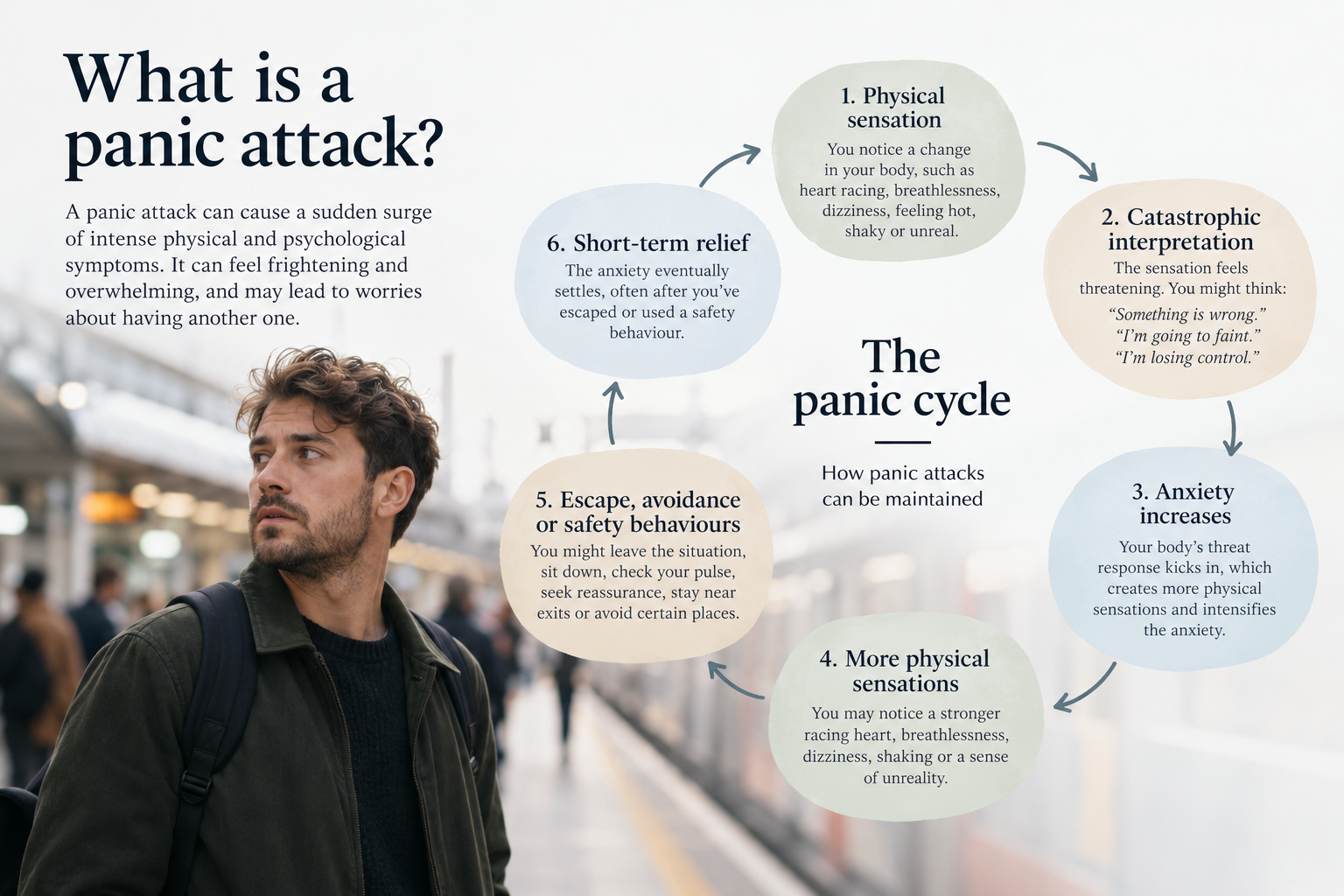
Understanding the panic cycle
Panic can develop into a self-reinforcing cycle.
You notice a physical sensation
Heart racing, dizziness, breathlessness, feeling hot, shaky or unreal.
↓
The sensation feels threatening
“Something's wrong.”
“I'm going to faint.”
“I'm losing control.”
↓
Anxiety increases
Your body's threat response creates more physical sensations.
↓
The sensations seem to confirm that something dangerous is happening
↓
You escape, avoid, monitor yourself or do something to feel safer
↓
Anxiety eventually falls
This can leave you with the impression that you only got through the situation because you escaped or kept yourself safe.
Next time you notice the same sensation, it can feel even more threatening.
CBT helps us interrupt this cycle.
How can CBT help with panic?
CBT isn't simply about learning how to calm yourself down.
We'll start by developing an individual understanding of your panic attacks, including:
the sensations you notice
what you fear those sensations mean
where your attention goes
what you do to prevent the feared outcome
situations you've started avoiding
things you've come to rely on to feel safe
We can then begin testing the predictions keeping panic going.
For example, if you've come to believe:
“If my heart starts racing, I'll lose control.”
talking about whether that's true will only get us so far.
Instead, CBT uses behavioural experiments to help you discover what actually happens.
Becoming less afraid of the sensations
An important part of CBT for panic can involve deliberately experiencing some of the physical sensations you've become frightened of.
This is sometimes called interoceptive exposure.
Where appropriate, we might use exercises that safely reproduce sensations associated with panic and observe what happens when you experience them without immediately trying to stop, escape or control them.
The aim isn't to make you uncomfortable for the sake of it.
It's to help you learn through experience:
“I can experience this sensation without treating it as an emergency.”
As your understanding of the sensations changes, they can become much less frightening.
Reducing avoidance and safety behaviours
Panic can also gradually change what you do.
You might stop exercising, travelling alone, using public transport, driving certain routes or going somewhere without an easy escape.
Or you might continue doing those things, but only while using particular precautions.
These behaviours make sense when you believe you're protecting yourself from something dangerous. The problem is that they can prevent you from discovering that you might have coped without them.
Treatment therefore involves gradually approaching avoided situations and reducing unnecessary safety behaviours.
The goal isn't simply to tolerate feeling anxious.
It's to regain freedom from the rules panic has created.
What working together looks like
Treatment is based on your individual formulation rather than simply giving you generic anxiety-management techniques.
Together, we may work on:
Understanding your panic cycle
Identifying the thoughts, sensations and behaviours keeping the problem going.
Testing frightening predictions
Using behavioural experiments to find out what actually happens.
Changing your response to bodily sensations
Learning to experience sensations without immediately treating them as dangerous.
Reducing safety behaviours and avoidance
Gradually stepping away from things panic has led you to rely on.
Getting back to what matters
Rebuilding confidence in activities and situations panic has pushed you away from.
Most of the useful learning happens in everyday life, so we'll usually agree things to practise or test between sessions.
Frequently asked questions
-
No. You don't need a formal diagnosis before getting in touch.
The assessment will help us understand what you're experiencing, what's keeping it going and whether CBT for panic is likely to be appropriate.
-
Physical symptoms shouldn't automatically be assumed to be anxiety. New, unexplained or concerning symptoms may need appropriate medical assessment.
Where physical symptoms have been medically considered but fear, monitoring and avoidance continue, CBT can help us look at how you're interpreting and responding to those sensations.
-
Yes. I offer CBT online across the UK as well as face-to-face appointments in Winchester.
Much of the treatment involves making changes and testing predictions in everyday life, so the work isn't limited to what happens during the therapy session.
-
There isn't a fixed number. Treatment length depends on your individual difficulties, goals and progress.
We'll agree what we're working towards and regularly review whether therapy is helping you get there.
Ready to start breaking the panic cycle?
If fear of panic attacks or bodily sensations is starting to dictate where you go, what you do or how safe you feel, CBT can help you understand what's keeping the cycle going and start responding differently.
You don't need to know whether ‘panic disorder’ is the right diagnosis before getting in touch.
Book a free 15-minute consultation to briefly discuss what you're experiencing and whether CBT might be suitable for you.