

CBT for Obsessive Compulsive Disorder (OCD)
Evidence-based online CBT and Exposure and Response Prevention (ERP) for adults struggling with intrusive thoughts, compulsions, checking, reassurance seeking and avoidance.
OCD can take up an enormous amount of mental space.
You might know that what you're doing isn't helping, but still feel compelled to check, analyse, seek reassurance, avoid something, repeat an action or work out whether a thought ‘means something’.
The relief usually doesn't last.
That's because the things that make anxiety drop in the short term can keep OCD going in the long term.
CBT for OCD focuses on changing that cycle.
Online CBT sessions | 50 minutes | £85
What keeps OCD going?
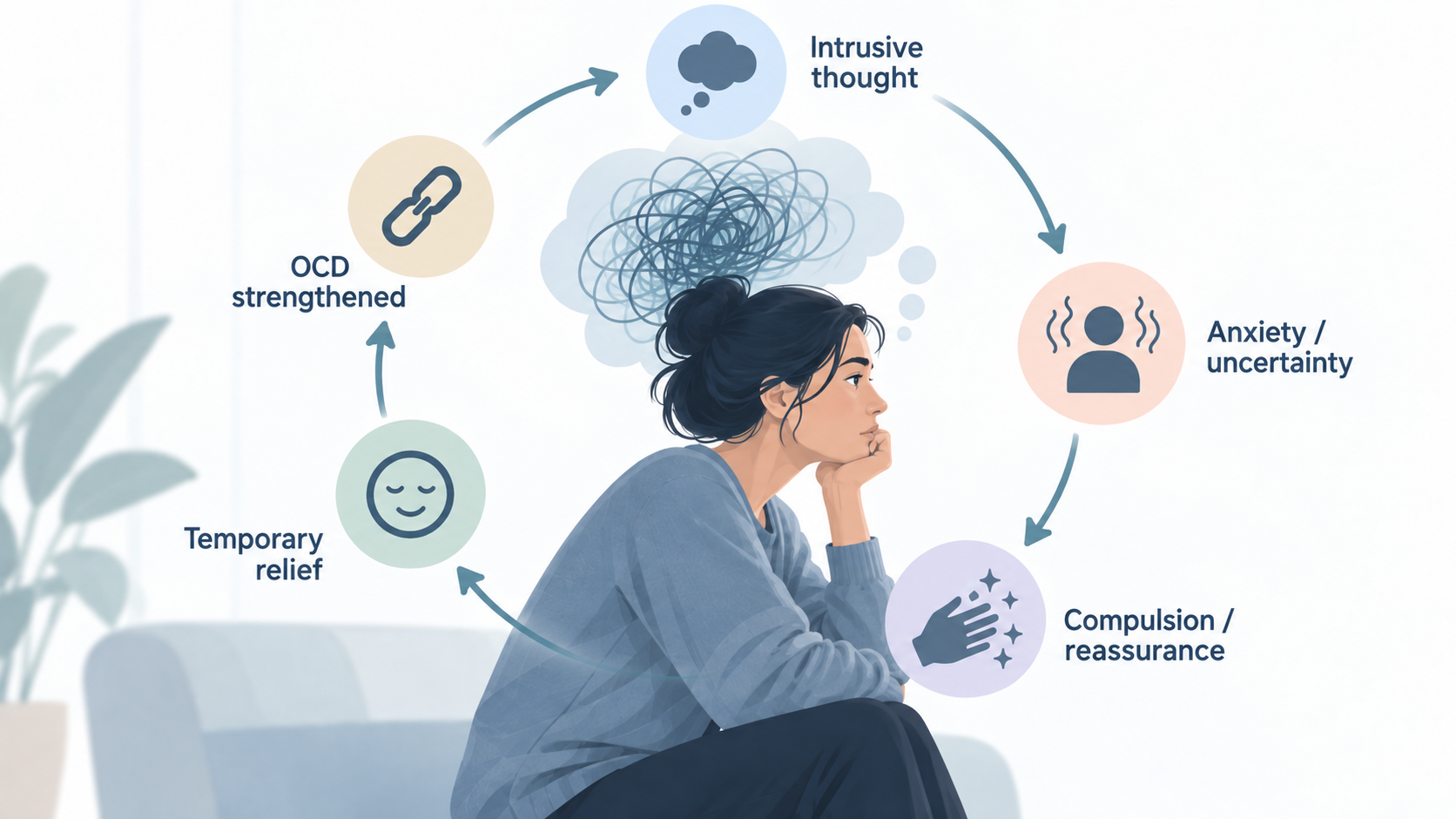
A typical OCD cycle looks something like this:
Intrusive thought, image, urge or doubt
↓
Anxiety, guilt, disgust or uncertainty
↓
Checking, reassurance, avoidance, rumination or another compulsion
↓
Temporary relief
↓
The brain learns that the compulsion was necessary
↓
The doubt becomes more important next time
Compulsions make sense in the moment.
If checking makes your anxiety fall from 90% to 30%, your brain naturally wants you to check again next time. The problem is what your brain learns from that relief.
Instead of learning:
“I felt uncertain and nothing needed to be done.”
it learns:
“That was dangerous. The checking helped me stay safe.”
Over time, the rules can become stricter, the compulsions more elaborate and your life smaller.
CBT and ERP aim to reverse that learning.
How CBT for OCD works
CBT for OCD is active. We don't simply talk about your week and hope the problem gradually improves.
We'll build a clear understanding of your OCD cycle, identify what is maintaining it and work directly on those processes.
Exposure and Response Prevention
ERP involves gradually approaching situations, thoughts, sensations or uncertainty that OCD has taught you to fear while reducing the compulsions you normally use to feel safe.
That might involve:
leaving something unchecked
reducing reassurance seeking
allowing an intrusive thought to be present without analysing it
touching something you would normally avoid
sending a message without repeatedly rereading it
tolerating not knowing with complete certainty
allowing something to feel “not quite right” without correcting it
The aim isn't to make you anxious for the sake of it.
It's to give your brain new information.
You learn that anxiety can rise and fall without a compulsion, uncertainty can be tolerated, and thoughts don't need to be solved simply because they feel important.
Behavioural experiments
We may also test the rules and predictions sitting underneath the OCD.
For example:
“If I don't check, I'll be responsible if something bad happens.”
Rather than endlessly debating whether that belief is true, we can design experiments that help you gather new evidence through experience.
That is often far more useful than reassurance.
What CBT for OCD isn't
CBT isn't about convincing you that your feared outcome definitely won't happen.
That can easily become another form of reassurance.
It also isn't about forcing you straight into the most frightening thing you can imagine. Good ERP is collaborative, planned and purposeful.
We'll usually build towards more difficult work rather than throwing you in at the deep end.
The goal isn't perfect certainty. It's reaching the point where uncertainty no longer dictates what you do.
What about “Pure O”?
Some people experience OCD with relatively few visible compulsions.
The compulsions happen internally instead.
You might:
review memories
analyse what a thought means
check how you feel
compare your reactions
mentally reassure yourself
repeat phrases
replace one thought with another
repeatedly work through the same question looking for certainty
This is sometimes described as “Pure O”, although there are still usually compulsive responses maintaining the problem.
They're simply harder to see.
Treatment involves identifying those mental rituals and learning to respond differently to the intrusive thoughts and uncertainty driving them.
What working with me looks like
I offer online CBT for adults with OCD across the UK.
I'm a BABCP-accredited CBT therapist with experience delivering CBT within NHS Talking Therapies.
Treatment is structured around your individual OCD rather than a generic worksheet programme.
In therapy, we may work on:
Understanding the cycle
Identifying what triggers OCD and what happens next.
Spotting compulsions
Including obvious behaviours and less visible mental rituals.
Reducing checking and reassurance
Helping you step away from strategies that create short-term relief but strengthen OCD long term.
Building ERP exercises
Planned, manageable opportunities to approach uncertainty differently.
Testing predictions
Using behavioural experiments rather than endless debate.
Getting life back
Re-engaging with activities, relationships and situations OCD has interfered with.
Most of the important change happens in everyday life rather than during the 50 minutes we're speaking, so we'll usually agree specific work to practise between sessions.
Sessions are 50 minutes and cost £85.
Before booking therapy, you can arrange a free 15-minute consultation so we can briefly discuss what's happening and whether CBT for OCD looks like the right fit.
Common questions
Do I need an OCD diagnosis?
No. You don't need a formal diagnosis before contacting me.
Part of the initial assessment is understanding what you're experiencing, how the problem operates and whether CBT is an appropriate treatment.
If what you're describing doesn't look like OCD, I'll tell you.
Can OCD therapy work online?
Yes. OCD treatment is often particularly well suited to online CBT because the work needs to transfer into your real environment.
ERP might involve things within your own home, your phone, your routines or situations you encounter between sessions.
Therapy doesn't have to remain something that happens only inside a consulting room.
Will I have to talk about intrusive thoughts I'm ashamed of?
You can talk about intrusive thoughts that feel disturbing, embarrassing or completely at odds with who you are.
People with OCD often spend years hiding certain thoughts because they fear what another person will think of them.
The presence of an unwanted thought isn't the same thing as an intention or action.
Understanding the meaning you've attached to the thought — and how you respond when it appears — is often central to treatment.
How long does CBT for OCD take?
There isn't one fixed number of sessions.
It depends on how severe the OCD is, how many areas of life it affects, whether there are multiple compulsions or avoidance strategies, and how much work you're able to practise between sessions.
We'll review progress rather than continuing therapy indefinitely without a clear rationale.
Ready to start tackling the OCD cycle?
If intrusive thoughts, checking, reassurance, mental rituals or avoidance are taking over more of your life than you want them to, CBT can help you understand what's happening and start responding differently.
You don't need to have worked everything out before getting in touch.
Book a free 15-minute consultation to discuss whether online CBT for OCD could be suitable for you.
[Book your free consultation]